15 English tests · single GPU

Index TTS 2.5 Review: Local Voice Cloning Tested

A hands-on English voice-cloning review with verified reference inputs, playable outputs, duration and emotion controls, measured single-GPU runtime, setup notes, and the limitations a production application must handle.

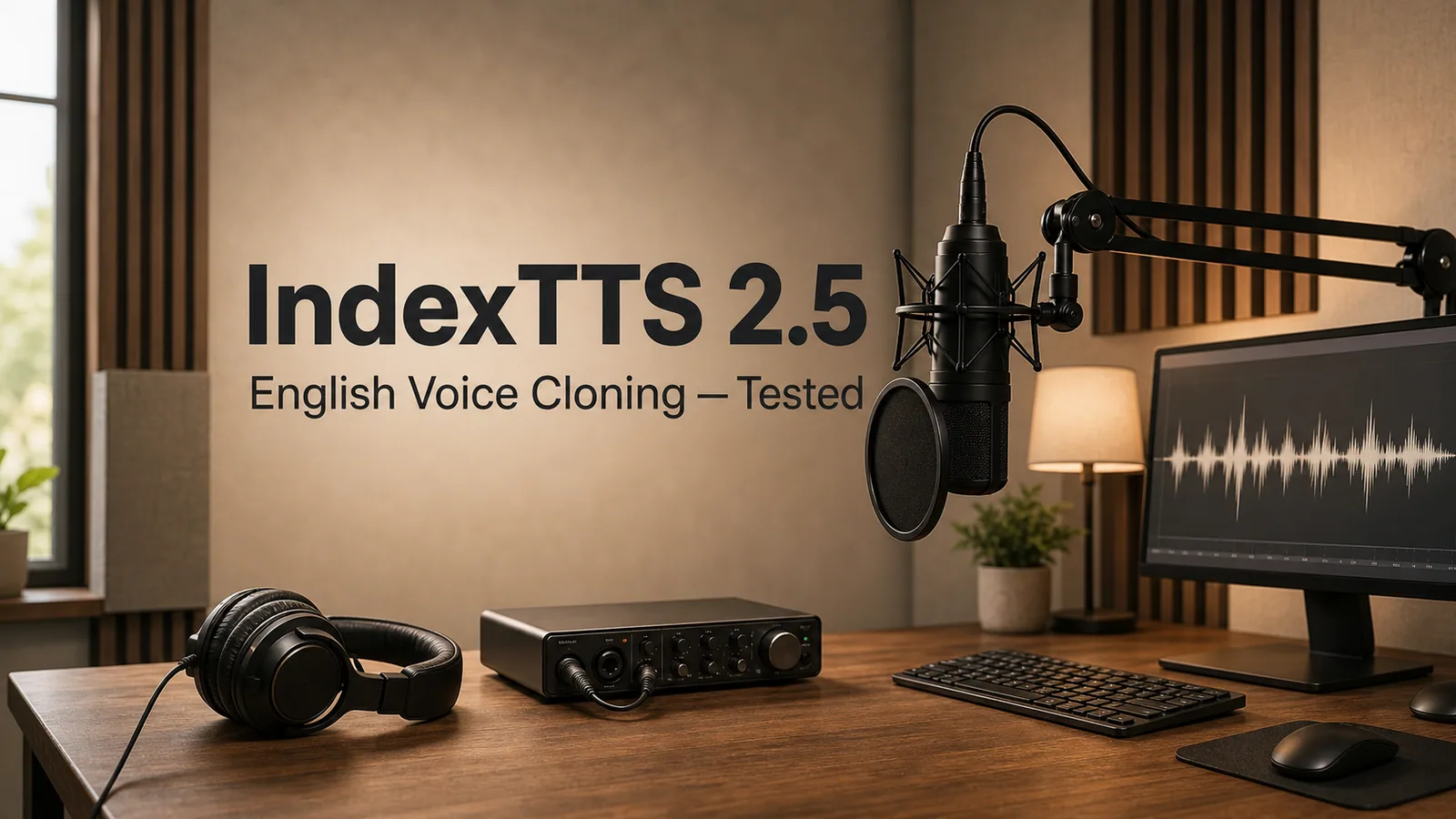
Index TTS 2.5 English voice cloning review in a recording studio

1.54 s

Median inference

0.230

Median wall RTF

7.61 GiB

Peak measured VRAM

15 / 15

Valid WAV outputs

A capable engine ready for a serious audition

The functional and performance results are encouraging, but generated files alone do not prove naturalness, speaker similarity, or emotional authenticity.

My practical verdict

Index TTS 2.5 is a strong self-hosted candidate for English voice cloning when a project needs duration control, emotion-vector conditioning, inline pronunciation overrides, and a straightforward local WebUI. Short outputs were usually produced in roughly one to two seconds after model loading in this sequential test.

It is not a finished drop-in service. The WebUI is an evaluation surface, not an authenticated production API. Unsupported language values, structured content, consent, access control, abuse prevention, and editorial review must be handled by the surrounding application.
Verified

Local deployment, repeatable generation, output integrity, timing, VRAM, and duration behavior.

Partially verified

English intelligibility through an ASR edit proxy; structured content was weaker.

Human review required

Naturalness, speaker similarity, cloned identity, and emotion quality remain listening judgments.

What was measured—and what was not

One isolated environment, official weights, sequential requests, fixed comparisons, and an explicit boundary case.

Evidence captured per output

  • Duration, sample rate, channel count, PCM subtype, and file hash
  • End-to-end wall time, wall real-time factor, process VRAM, and sampled GPU utilization
  • Independent Whisper-small transcript compared with target text as a rough edit proxy
  • Identical text, reference, and seed inside control comparisons where applicable

Limits of the evidence

  • ASR can detect omissions, but it cannot score timbre, emotion, or naturalness.
  • One male and one female read-English reference do not represent every accent, age, microphone, or style.
  • Single sequential requests do not predict multi-user throughput or queue behavior.
  • This was not a matched Index TTS 2 or competitor benchmark.

Hear the exact voice-cloning inputs

Both clips are converted WAV excerpts from the OpenSLR LibriSpeech test-clean corpus. Input and output should always be reviewed together.

Male reference · 5.07 s

Official LibriSpeech test-clean excerpt

“This was so sweet a lady, sir, and in some manner I do think she died.”

Female reference · 6.73 s

Official LibriSpeech test-clean excerpt

“Horse sense: a degree of wisdom that keeps one from betting on the races.”

Fast local generation with a clear memory ceiling

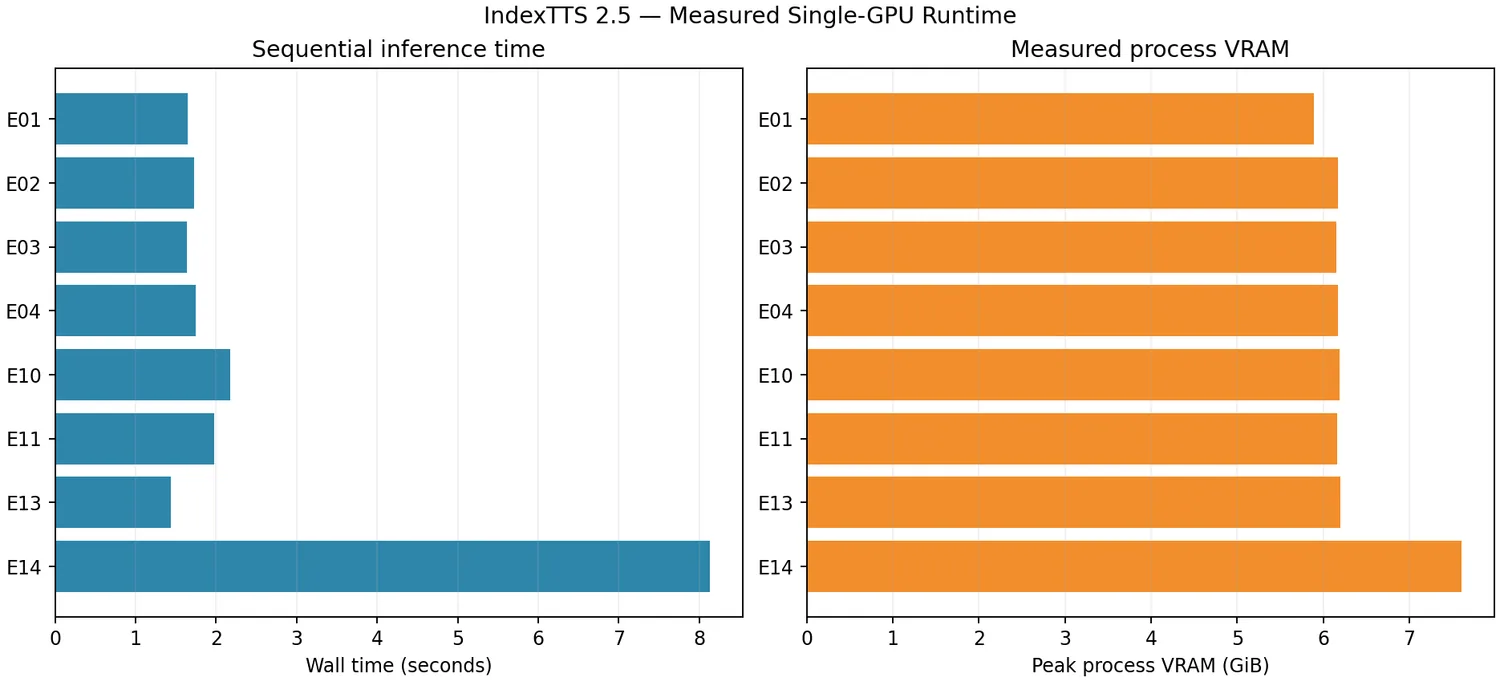
All 15 calls produced valid mono 16-bit PCM WAV files at 22.05 kHz. The 14 normal cases generated 119.06 seconds of audio.

Bar chart comparing measured Index TTS 2.5 inference time and process VRAM across representative tests
Index TTS 2.5 English voice cloning test metrics
IDTestReferenceAudioInferenceWall RTFPeak VRAMASR proxy
E01Baseline · male referenceMale5.14 s1.65 s0.3216,030 MiB0.00
E02Baseline · female referenceFemale6.83 s1.73 s0.2536,318 MiB0.00
E03Shared sentence · maleMale6.06 s1.63 s0.2706,300 MiB0.00
E04Shared sentence · femaleFemale6.86 s1.74 s0.2546,320 MiB0.08
E05Duration · factor 0.8Male4.78 s1.41 s0.2956,234 MiB0.14
E06Duration · factor 1.0Male5.99 s1.27 s0.2116,234 MiB0.14
E07Duration · factor 1.2Male7.19 s1.38 s0.1926,234 MiB0.14
E08Pronunciation · plain “minute”Male4.47 s0.99 s0.2236,234 MiB0.00
E09Pronunciation · CMU “minute”Male4.27 s0.98 s0.2306,234 MiB0.08
E10Stress · numbers, date, currencyMale10.46 s2.17 s0.2086,334 MiB0.15
E11Stress · acronyms and emailFemale8.10 s1.97 s0.2446,310 MiB0.25
E12Emotion · neutral controlFemale5.67 s1.31 s0.2306,344 MiB0.00
E13Emotion · sad vector 0.8Female6.47 s1.44 s0.2236,344 MiB0.00
E14Long form · English passageMale36.77 s8.13 s0.2217,790 MiB0.11
E15Boundary · invalid language codeMale5.14 s1.11 s0.2157,790 MiB0.78

Play all 15 generated outputs

Open any row to audition the actual WAV. Players request only duration metadata first; full audio loads when you choose to play it.

E01 · Male reference

Baseline · male reference

5.14 s

Inference 1.65 s · Wall RTF 0.321 · Peak VRAM 6,030 MiB · ASR proxy 0.00

E02 · Female reference

Baseline · female reference

6.83 s

Inference 1.73 s · Wall RTF 0.253 · Peak VRAM 6,318 MiB · ASR proxy 0.00

E03 · Male reference

Shared sentence · male

6.06 s

Inference 1.63 s · Wall RTF 0.270 · Peak VRAM 6,300 MiB · ASR proxy 0.00

E04 · Female reference

Shared sentence · female

6.86 s

Inference 1.74 s · Wall RTF 0.254 · Peak VRAM 6,320 MiB · ASR proxy 0.08

E05 · Male reference

Duration · factor 0.8

4.78 s

Inference 1.41 s · Wall RTF 0.295 · Peak VRAM 6,234 MiB · ASR proxy 0.14

E06 · Male reference

Duration · factor 1.0

5.99 s

Inference 1.27 s · Wall RTF 0.211 · Peak VRAM 6,234 MiB · ASR proxy 0.14

E07 · Male reference

Duration · factor 1.2

7.19 s

Inference 1.38 s · Wall RTF 0.192 · Peak VRAM 6,234 MiB · ASR proxy 0.14

E08 · Male reference

Pronunciation · plain “minute”

4.47 s

Inference 0.99 s · Wall RTF 0.223 · Peak VRAM 6,234 MiB · ASR proxy 0.00

E09 · Male reference

Pronunciation · CMU “minute”

4.27 s

Inference 0.98 s · Wall RTF 0.230 · Peak VRAM 6,234 MiB · ASR proxy 0.08

E10 · Male reference

Stress · numbers, date, currency

10.46 s

Inference 2.17 s · Wall RTF 0.208 · Peak VRAM 6,334 MiB · ASR proxy 0.15

E11 · Female reference

Stress · acronyms and email

8.10 s

Inference 1.97 s · Wall RTF 0.244 · Peak VRAM 6,310 MiB · ASR proxy 0.25

E12 · Female reference

Emotion · neutral control

5.67 s

Inference 1.31 s · Wall RTF 0.230 · Peak VRAM 6,344 MiB · ASR proxy 0.00

E13 · Female reference

Emotion · sad vector 0.8

6.47 s

Inference 1.44 s · Wall RTF 0.223 · Peak VRAM 6,344 MiB · ASR proxy 0.00

E14 · Male reference

Long form · English passage

36.77 s

Inference 8.13 s · Wall RTF 0.221 · Peak VRAM 7,790 MiB · ASR proxy 0.11

E15 · Male reference

Boundary · invalid language code

5.14 s

Inference 1.11 s · Wall RTF 0.215 · Peak VRAM 7,790 MiB · ASR proxy 0.78

What changed across voice, emotion, and duration

These paired tests establish measurable control behavior. They do not replace a blind human listening panel.

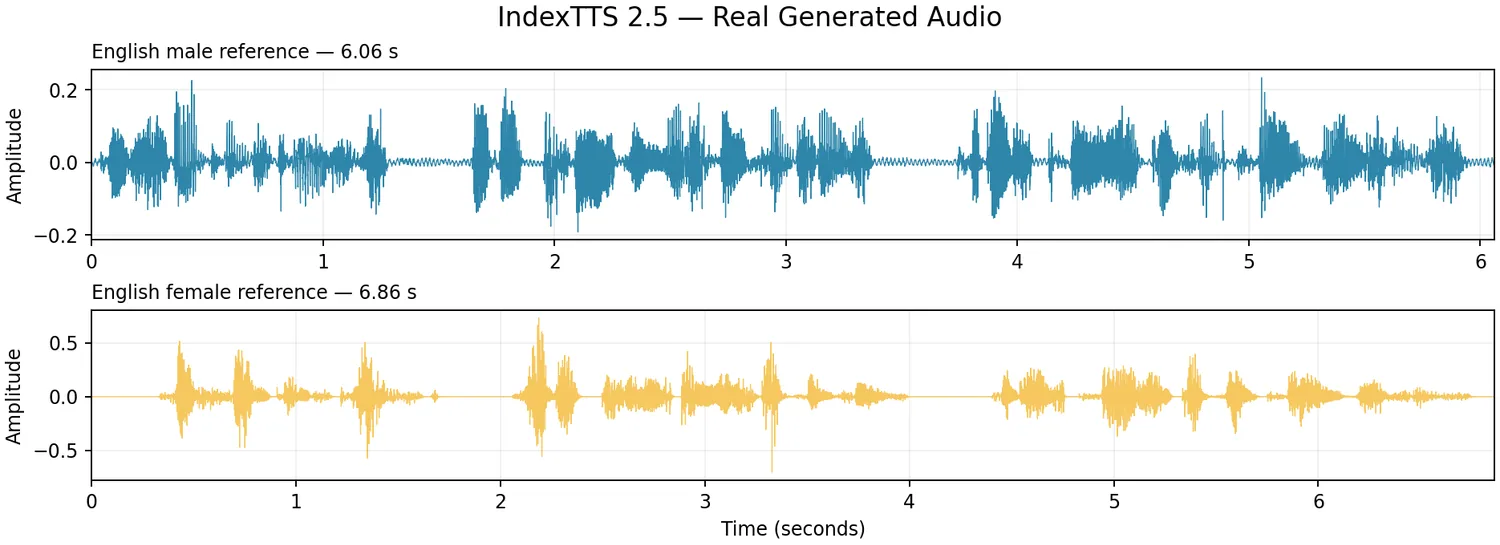
Waveform comparison of one English sentence generated from male and female reference voices

Male and female references changed the output

The same new sentence lasted 6.06 seconds with the male reference and 6.86 seconds with the female reference. Waveform and pacing differences confirm that the speaker condition affected generated speech, not merely file metadata.

This is not a formal speaker-similarity score. A reliable cloning study would add blind ratings, speaker embeddings, several sentences, and listeners familiar with each source voice.

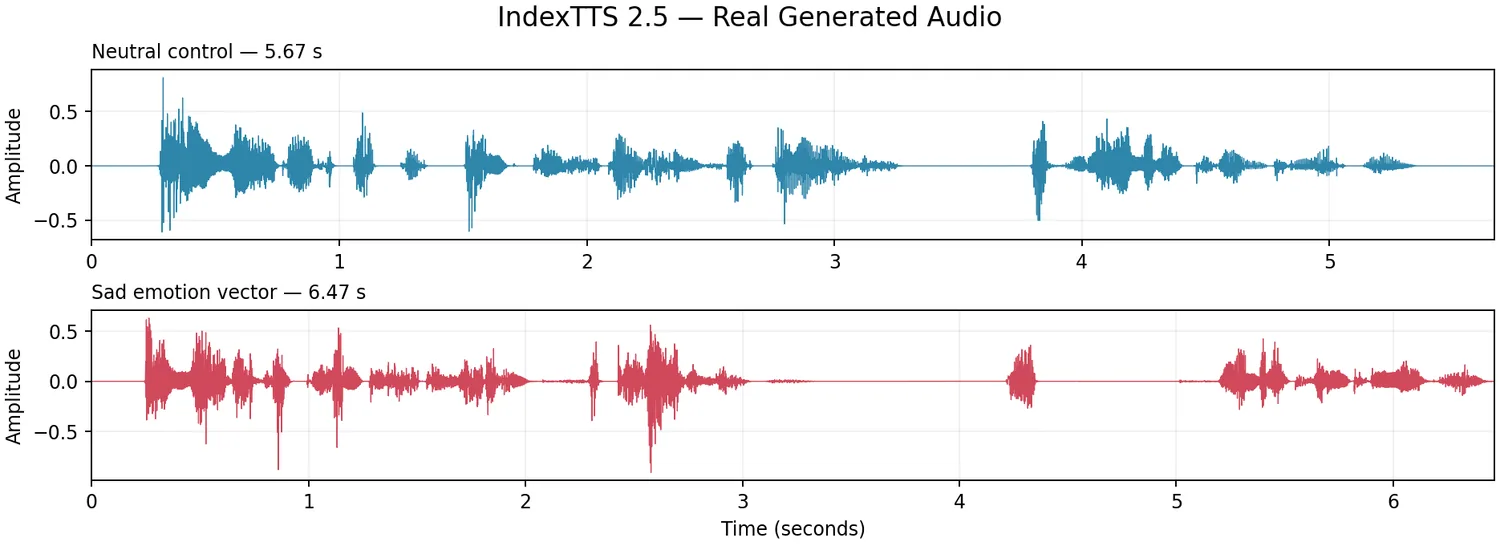
Waveform comparison between neutral and sad emotion-vector Index TTS 2.5 outputs

Measurable change, unresolved perceptual quality

Identical text and the same female reference produced 5.67 seconds under the neutral condition and 6.47 seconds with the sad vector set to 0.8. Both ASR transcripts preserved the full target sentence, while timing and waveform envelopes changed.

Human listeners still need to decide whether sadness increased naturally and whether cloned identity stayed stable. Production presets should be auditioned at several strengths and locked per approved voice.

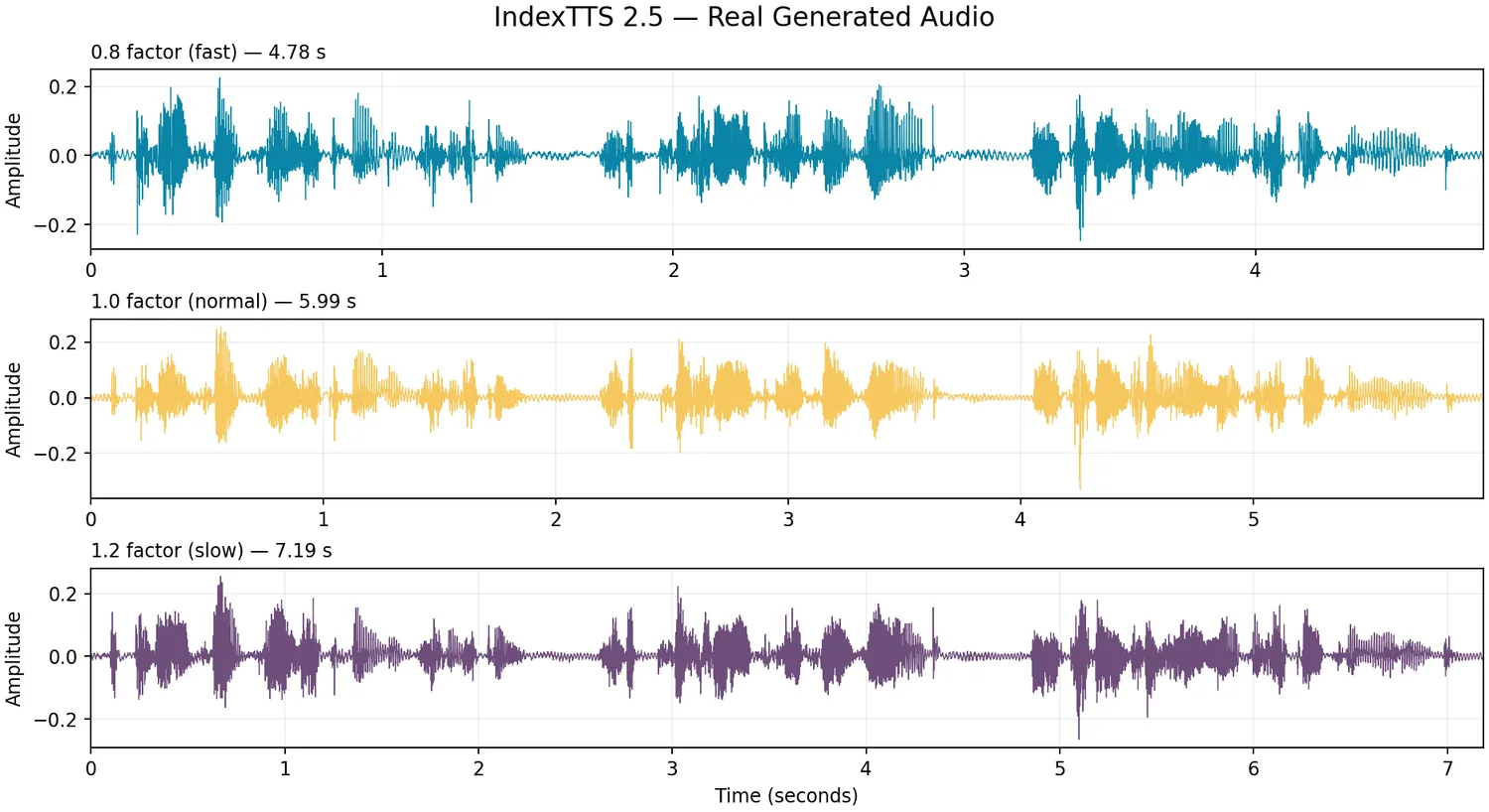
Waveform comparison for Index TTS 2.5 duration factors 0.8, 1.0, and 1.2

Duration scaled almost exactly as configured

With the same English text, voice, and seed, factor 0.8 produced 4.78 seconds, factor 1.0 produced 5.99 seconds, and factor 1.2 produced 7.19 seconds. The measured ratios were 0.799 and 1.200 relative to normal.

A smaller factor creates a shorter, faster result; a larger factor creates a longer, slower result. All three preserved the sentence in the automated transcript with minor recognition variation, but natural pacing still needs listening review.

Numbers and identifiers need editorial guardrails

Pronunciation controls are useful, but structured content can fail in ways a normal sentence does not.

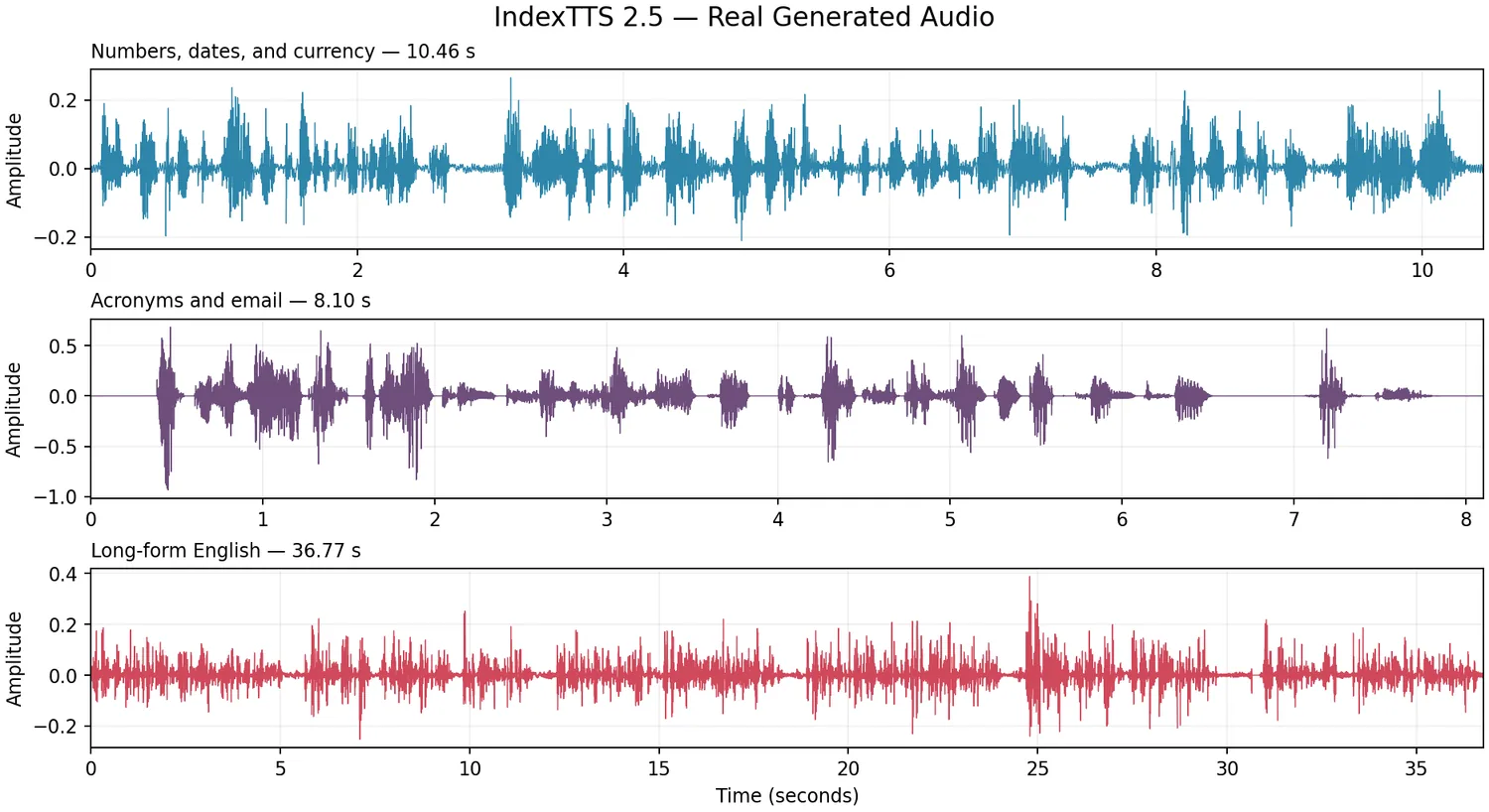
Waveforms from Index TTS 2.5 English tests containing dates, currency, time, acronyms, and an email address

Operational—not automatically publication-safe

Inline CMU syntax was accepted for an English homograph, and both plain and annotated versions preserved the written sentence in ASR. Word-level transcription cannot prove that vowel and stress were perceptually correct, so pronunciation still needs a listener.

The numbers/date/currency test changed some spoken normalization and truncated the time. The acronym/email test kept AI and CSV but rendered the email address as spoken text. Invoices, support numbers, addresses, legal copy, and identifiers need explicit normalization and preview.

One completion success and one validation failure

These two cases are the strongest reminder that model behavior and application safety are different engineering problems.

Long-form output reached the final sentence

The multi-sentence English case generated 36.77 seconds of audio in 8.13 seconds and reached its explicit final confirmation sentence according to ASR. Peak process VRAM rose to 7.61 GiB. A noticeable stutter kept the content-fidelity result partial rather than passed.

Audiobook production still needs sectioning, retry boundaries, identity checks over minutes, deterministic stitching, and review before concatenation.

Unsupported language code generated distorted audio

The intentionally invalid KLINGON value was accepted instead of returning a clear validation error. It generated degraded speech with an ASR proxy of 0.78. A public endpoint must validate language against an explicit allowlist before allocating GPU work.

Also validate empty text, maximum length, reference duration, file type, sample rate, annotation syntax, URLs, and other structured values.

Index TTS 2.5 with uv and Hugging Face

A clean Linux-oriented route using the official repository and IndexTeam model package. Verify compatibility on your own CUDA stack.

bash
git clone https://github.com/index-tts/index-tts.git
cd index-tts

python3 -m pip install --user -U uv
uv sync --python /usr/bin/python3.10 --extra webui

uv run hf download IndexTeam/IndexTTS-2.5 \
  --local-dir checkpoints

uv run webui.py \
  --host 127.0.0.1 \
  --port 7860 \
  --model_dir ./checkpoints \
  --fp16

Tested environment

Operating system
Linux x86-64
Python
3.10
Environment
uv project environment
PyTorch / CUDA
2.8.0 / CUDA 12.8
GPU mode
One NVIDIA GPU, sequential requests
Output
22.05 kHz mono PCM WAV

Bind the evaluation UI to 127.0.0.1 by default. If remote access is required, place it behind authenticated transport rather than exposing the Gradio port directly.

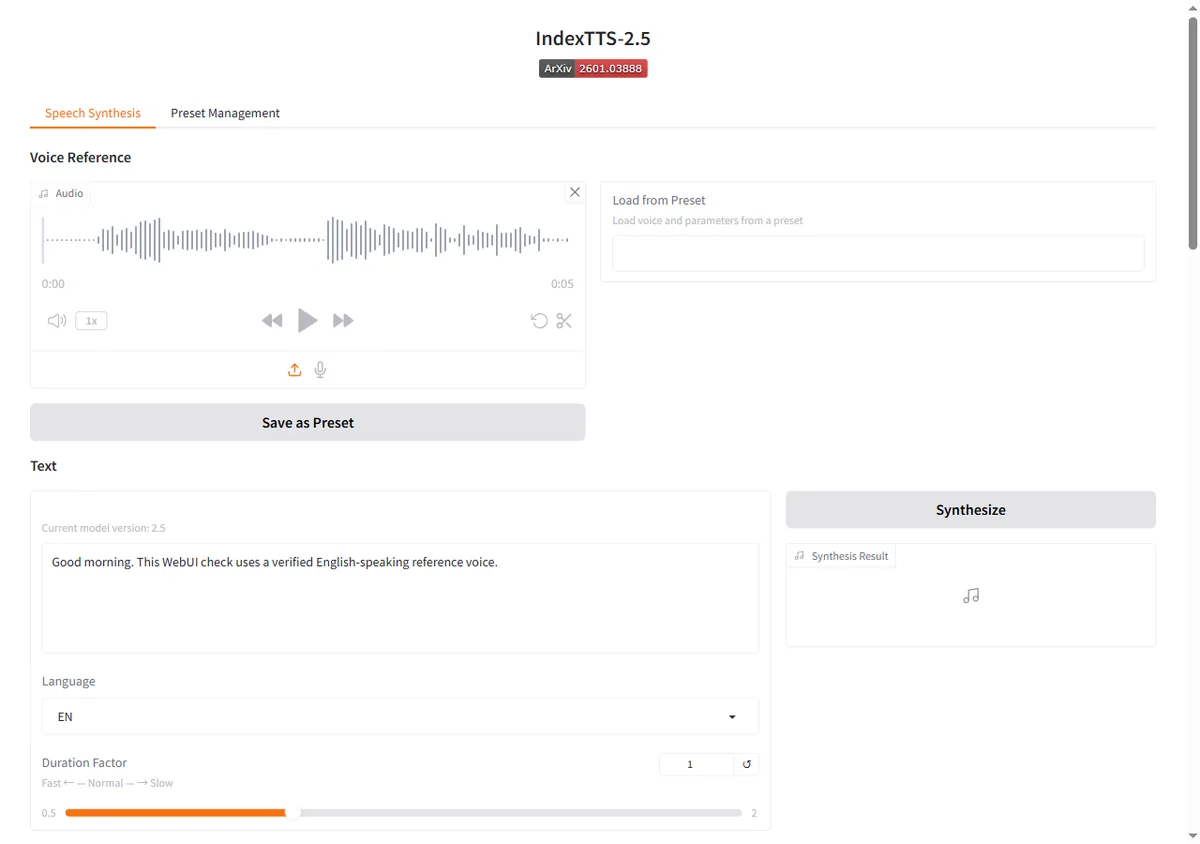
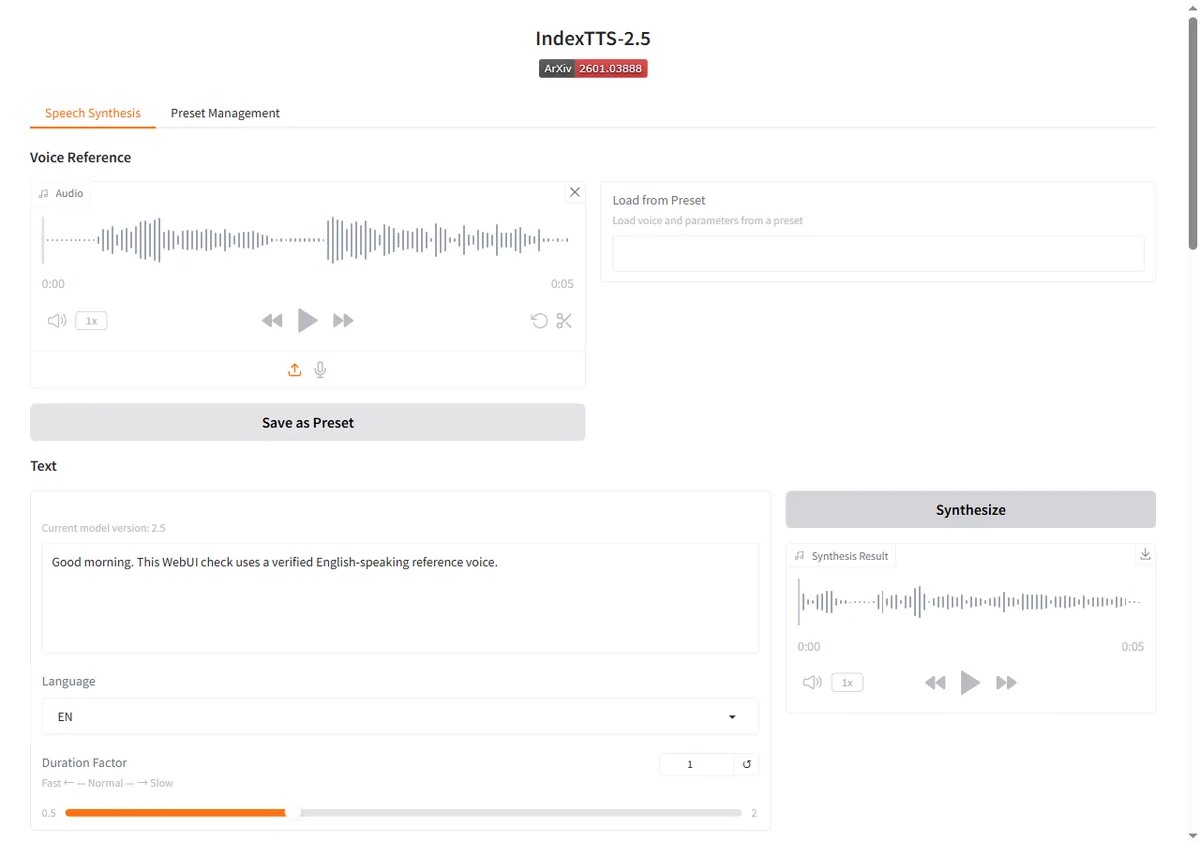
Completed English voice-cloning input in the local Index TTS 2.5 WebUI
Generated English audio result in the local Index TTS 2.5 WebUI

Where Index TTS 2.5 fits—and where it does not

Choose by workload, license, language needs, operating model, and safety controls—not by one polished demo.

Strong fit

Private English narration, dialogue prototypes, local voice experiments, and workflows that benefit from duration, emotion-vector, and pronunciation controls.

Compare first

Evaluate Qwen3-TTS or CosyVoice when broader official language coverage, streaming architecture, or an Apache-licensed repository dominates the decision.

Production prerequisites

Consent records, custom-license review, authentication, reference-audio protection, validation, rate limits, abuse monitoring, and listening approval.

License and consent notice: the model package uses a custom model license, not a generic permissive software license. Review the supplied license and obtain professional advice for material commercial deployment. Only clone voices with informed authorization covering the intended use.

Index TTS 2.5 review FAQ

Clone the official repository, create the environment with uv, download IndexTeam/IndexTTS-2.5 into the checkpoints directory, and launch webui.py. The tested-style commands are included on this page.

Run a listening test with your own authorized voices

The supplied numbers establish one reproducible functional test. Your adoption decision should use representative speakers, scripts, languages, recording conditions, and a blind human review.

Sources supplied with the evaluation package: